

Article
What is a Stained Glass Window?
By Dr. Shirley Ann Brown
While stained glass windows are omnipresent, they’re often an overlooked artistic and cultural component of our built environment.
Light MattersLooking at a stained glass window is not like looking at a painting on canvas, plaster or board. Stained glass relies on transmitted, rather than reflected light for its effectiveness, as it’s the light passing through the coloured glass that renders the window readable.
Any light reflected off the surface of the glass interferes with the image and deadens the colours. A stained glass window is best viewed in a semi-darkened interior during the daytime. At night, it is normally best seen from the outside of a lighted building.
Appreciating Stained Glass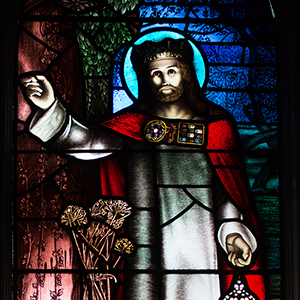
The Light of the World, c. 1955
St. Thomas' Anglican Church, St. John’s, NL.
McCausland Ltd. or Luxfer Studios, Toronto.
Photo: ©MDS
In order to fully appreciate a stained glass window, one of the key factors to consider is the main material employed. Technically, stained glass is glass that is coloured by introducing metal oxides to the glass while it’s in the molten state in the furnace. Sometime referred to as “pot metal glass,” the glass is coloured throughout its body. A broken piece will reveal colour all the way through.
Mosaic of Small PiecesA traditional stained glass window is actually a mosaic of fairly small pieces of flat coloured glass, sometimes painted. It is held together by a network of H-shaped lead strips, called “cames,” all of which are secured into an opening by an iron armature.
Painting the GlassThe use of paint is restricted, and generally used to model forms and draw the linear details found in faces, hands, etc.
At first, only two types of paint were used, one being brownish in tone and the other producing a variety of yellows. Over time, coloured vitreous paint was used. All paint is fired onto the glass in a kiln to create a permanent bond.
Glass left in the original, almost colourless state to which vitreous paint or yellow stain has been applied and fired for permanency, is also considered “stained glass,” as are windows created out of unpainted coloured glass leaded together into interesting patterns. Modern technology has made it possible to create stained glass windows from strong, larger sheets of glass to which designs can be applied without the use of the lead cames.
Many Types of BuildingsLike all windows, the primary physical purpose of a stained glass window is to complete the building envelope, to act as a barrier against the elements, but also to admit light. Although generally associated with religious architecture, stained glass windows can be found in many forms of secular buildings – residences, government buildings, schools, hospitals, banks, company headquarters, subway stations, among others. As such, it can function as a status marker, advertisement, historical reminder, or as a decorative accessory to the structure.
Religious Stained Glass More ComplexBut ecclesiastical stained glass has always been more complex in its function than secular glass. It was, and is, intended to create a special, enclosed space separated both physically and metaphysically from the distractions of the outside secular world.
A 12th-century treatise, written by Abbot Suger, explains the two main non-physical purposes of the stained glass windows he had installed at St. Denis Abbey near Paris: pedagogical and symbolic. Images of saints and sacred narratives were to teach viewers the biblical stories and truths basic to their faith, and to provide exemplars of moral behaviour.
But Suger equally emphasized the transformative power of kinetic natural light. Invisible sunlight becomes visible when it passes through the coloured glass membrane of a window, picking up the jewel-like hues and filling the dark interior space with shafts of transformed radiance. As the sun moves through its daily passage, its illuminating power shifts along the line-up of the windows, constantly changing the colour and direction of the light projected into the interior. For Suger, this was a visible and tangible manifestation of the presence of God: Contemplation of the transformed light can elevate one’s thought to a meditation on Divine perfection and beauty. The same holds true today.
With a continuous history from medieval times to the present, stained glass windows – whatever their design or their age – blend the past and present into a continuous brilliant flow of light and colour.
Dr. Shirley Ann Brown is one of Canada’s foremost researchers of historic architectural stained-glass windows.